Tattoo Sheana,Amazing Tattoo,Tattoo Knuck,Tattoo Simple Girl,Sexy Nursing Maternity Bra with Tattoo,Temporary Tattoos Designs,Zodiac Tattoo Symbols,Rose Devil Girl Tattoo Color Design,Sexy Art Tattoos Designs,Feminine Tribal Tattoos.

Statues of Beautiful Penitents of Taxco, Mexico

In many countries especially those with past Spanish links, some Roman Catholic believers still follow the old medieval practice of painful and bloody self-penitence to atone for their sins. The town of Taxco, Mexico is perhaps the most famous for this ritual which takes place every year during the Easter week, where the repenting sinners known as "Penitentes" walk through cobbled winding streets of the old town.
The Penitentes always wear black dress and their head is also fully covered with black hood with small openings for eyes. The Penitentes are further categorised by the method of penance.
"Penitentes Flagelante" are those who walk the route shirtless and carry a large, heavy wooden cross in their arms. They carry a rosary and a whip with thorny metallic end in their hands. They frequently stop during the procession, give the heavy cross to attendees who accompany them and then flagellate (whip) their backs. This is repeated every night during Holy Week reopening the wounds of the earlier day.
"Penitentes Encruzado" are those who instead of the cross, carry a heavy bundle (40-50 kg.) of thorned blackberry canes which is tied across their bare back and outstretched arms. They are also helped by attendees who occasionally give support to the thorny bundle when the procession is not moving.
"Animas Penitentes" wear full black dress covering their whole body and also cover their head with hood. They have heavy chains attached to their ankles and walk in stooped bent posture carrying small crosses or lighted candles. As they always face the ground, these penitentes have attendants who guide them during the procession. When the procession stops, they are allowed to rest only by going down on hands and knees.
This is the only category in which women also take part.
To honour the Repenting Sinners, three statues, representing each category of the penitentes, have been installed behind the oldest monastery in the town - The ex-monastery of San Bernardino de Siena, constructed at the end of the 16th century.


Image from Wikimedia Commons is by User:Gengiskanhg

Image from Flickr is by weisserstier

Image from Flickr is by teques

Image from Flickr is by teques

View location in Google Earth / Google Street View

Source of info and more info: Wikipedia

Blue City of Jodhpur founded in 1459, ubiquitous blueness of Jodhpur

Blue City of Jodhpur, India

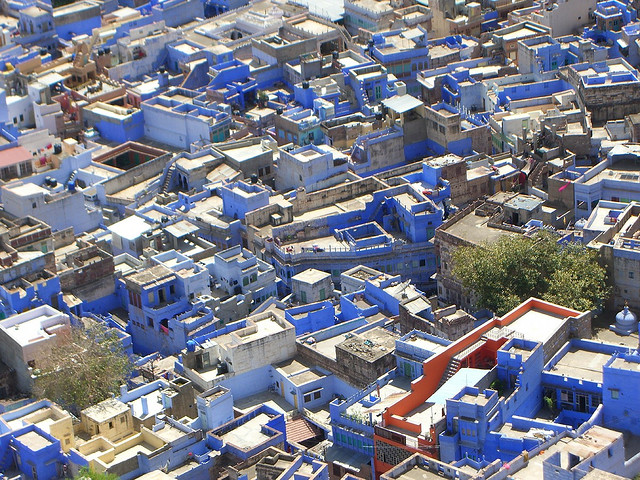
Travellers journeying through the desolate landscape of the unforgiving Thar desert in the Indian state of Rajasthan would know when they had reached their destination. The sky would fall to the ground and everything would become a single color – blue. Jodhpur would lie before them, opening up like a blue treasure in the desert.
Blue City of Jodhpur, India

Blue City of Jodhpur, India

Why the population of the fortress city – the Blue City as it is universally known – took to painting their houses in various shades of blue is not completely certain. Yet most believe it is to do with the prevailing caste system in India.
Blue City of Jodhpur, India

It is thought that Brahmins – members of the priestly class – first took to coloring their houses blue (yet perhaps it should really be called indigo) to signify their domicile and to set them apart from the rest of the population. Soon, however, the rest of the population followed suit. History does not tell us which brave non-Brahmin was the first to do it, yet it happened and since that day the people of Jodhpur have steadfastly maintained this tradition.

Blue City of Jodhpur, India

Ask a local why all the houses are painted thus and the usual reply is that the color keeps the interiors cool and fends of mosquitoes. Yet if this truly worked then it would be quite likely that the whole subcontinent would be awash in various hues of indigo.
Blue City of Jodhpur, India

Blue City of Jodhpur, India

More likely is symbolism. Although an unscientific response, what answer would most give when asked the color of water? It is likely that the ubiquitous blueness of Jodhpur is an exuberant display of human resilience against the stark Thar desert which surrounds the town. Against the bleak backdrop of parched brown earth the blue city exerts itself magnificently.
Blue City of Jodhpur, India

Blue City of Jodhpur, India

You might think that closer inspection would lessen the impact of the color, yet a look at many of Jodhpur’s streets immediately puts that idea to rest. The word unremitting springs immediately to mind.
Blue City of Jodhpur, India

Blue City of Jodhpur, India

Blue City of Jodhpur, India

The modern trappings of life go side by side with evidence that many people still live as simply as they have always done. Although Jodhpur was only founded in 1459, the state of Rajasthan is significant in Indian history as it formed the bedrock of the Indus Valley Civilization, thought to be one of the most ancient human civilizations on the planet.
Blue City of Jodhpur, India

Blue City of Jodhpur, India

Blue City of Jodhpur, India

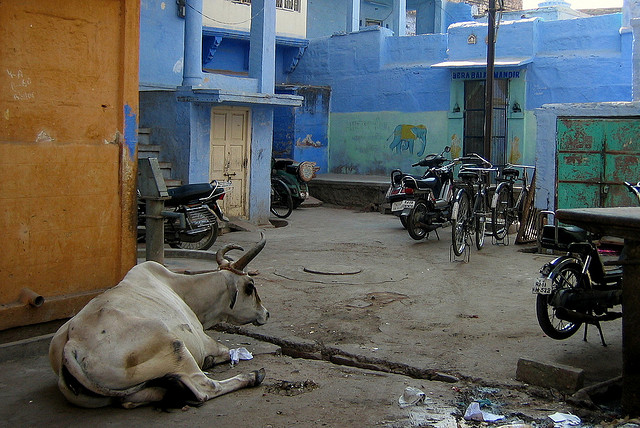
Perhaps the color has a calming effect but humans and animals seem to coexist peacefully side by side in Jodhpur. Even with the animals, inter-species friendships are not unheard of.
Blue City of Jodhpur, India

Blue City of Jodhpur, India

Blue City of Jodhpur, India

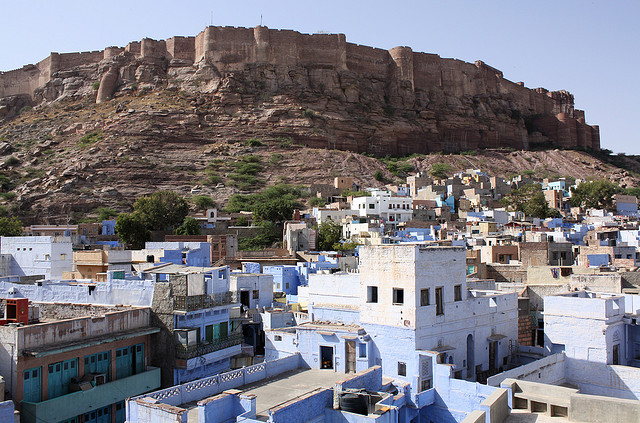
Squatting above the city like a giant bird mourning its broken blue eggs is the mighty Mehrangarh Fort the foundations of which were built in 1459, the year in which the English knight John Fastolf died – to be immortalised much later by Shakespeare as Falstaff.
Blue City of Jodhpur, India

Blue City of Jodhpur, India

The fort was ordered by Rao Jodha the ruler of Rathore who had decided to move his capital there. One legend has it that in order for the fort to be built the only human resident, a hermit, had to be forcibly evicted.
Blue City of Jodhpur, India

Blue City of Jodhpur, India

He cursed Jodha with the words May your citadel ever suffer a scarcity of water! Although the ruler did eventually appease the hermit by building him a temple the city is still hit by drought every four years or so.
Blue City of Jodhpur, India


A much darker legend is that of Rajiya Bhambi. Jodha promised that his family would be looked after eternally if he did one thing for him. The request was that he would be buried alive in the foundations of the fort. Rajiya agreed. To this day his descendants still live in a blue house on the land they were gifted by the ruler which is known as Rajiya’s garden.

The color of Jodhpur tells the history – and makes it legend - of a populace who shaped a paradise in the heart of the heat and sandstorms of Rajasthan.